Universities Quarterly 7(4), 1953, pp. 361-71.
THE concern of this article is with the prospect for International Relations as a teaching subject in British universities at the present time. In a sense, it might appear that there can be little to consider. It is on no great scale that this distinct branch of study has up to now been anywhere provided for at all. Even the idea of such a subject is only here and there squarely accepted. And yet this, in a way, is perhaps not really very astonishing, given the British sense of humour. In most other subjects the academic upper ten, for all their effortless humility, do presumably know about as much as men currently can. But a ‘professor’ of international relations! What would Gilbert not have made of such a role? What may Herbert not make of it yet!
Nor is it quite certain what even its salaried sponsors themselves may eventually be expected to make of it. There exists, as yet, little or nothing in the nature of an orthodoxy as to how it should be handled. In some respects it almost tends to be every teacher to his taste. It is therefore proper that any individual writer, and particularly this one, should underline in this regard the essentially personal nature of his opinions, long though he may have held them and consistently though they may have found reflection in his work. To him the question of definition has always seemed sufficiently simple. He starts from the premise that international relationships occur, that they matter, and that, if probed and pondered over, they may come to be understood better than they commonly are. From experience he knows that the desire so to understand them, and to have help in it, is not rare among the young. Of such help it is, he assumes, the task of anyone titularly a teacher of International Relations to give them all he can. And for the instructional medium which has its genesis in this activity it seems to him no more than natural to use International Relations as a name. A poor definition very possibly, but his own!
As with other disciplines, so also with this one, there are two contrasted footings on which it may occur in the curriculum for a first degree. It may constitute the kernel, or organizing centre, of a man’s pattern of academic preoccupations; or it may figure as ancillary to his specialization in one of other of the older-established lines. Even in the former event it should not, though it possibly does, need saying that International Relations is not proposed to be cultivated in the void. In either event it will stand as one of a constellation of studies: so that a degree will not be given on quality in this subject alone. D1plomat1c History, in particular, and Economics, and International Law are merely among the more obvious of the ones which, as ‘underpinning’ subjects, may well require to be taken concurrently by those for whom International Relations is the matter of staple concern.
Sometimes the question is asked whether International Relations is not, even so, a relatively advanced line of study, fit rather to be introduced at the postgraduate than at the first degree level. It cannot be enough to protest, in reply, that this would put the subject out of range for all except a minority of those who might be wishing to take 1t; not enough, for, if definitely unsuited to undergraduate uses, the subject should by all means be barred, at the undergraduate stage. But a more apposite answer, one may hope, is that Mathematics too can be taught as an advanced sort of subject; and that as much as Mathematics, International Relations admits, propitiously, of an elementary-level presentation. Indeed, it is the letting in of this subject at that earlier, more formative, level which is so notable a new development of today. Here speaks, admittedly, the one-eyed devotee. He must not reckon on any unquestioning assent to such a claim. These still are early days. Only lately has he himself been given experience of the teaching of International Relations – the groundwork of the matter – to men in their freshman year. What was for him at first no more than an expectation is now however a finding, which he hopes an· impartial investigator would confirm. He holds, in short, that the, The Structure of International Society (being first steps 1n International Relations) has already given proof enough of its possibilities, as well for those who will not, as for those who will, be proceeding to further formal studies in this field.
If a clue should now be desired to the contents of the packet from which even those of such perilously tender years are thus recommended to be fed, one at least may draw attention, by way of answer, to some axioms on the need that the teaching ought to fill. For it is assumed here as incontestable that, in a free democracy, some consciousness of things international is in principle a pre- requ1s1te for the salutary use of a vote; that the pursuit of the relevant understanding can never in a given instance be held fully to have gained its obJective; that the student should therefore be regarded as destined indefinitely to continue what at college he can barely have begun; that the teacher, himself too a student, is equally out on an endless quest; that several teachers, serving concertedly, should, at least in principle, be capable of more than one; but that if, after all, an individual teacher has reserves about the team approach, he may of course be reasoned with, but will not be expected, even in the general interest, to simulate sympathy in his teaching with methodological prepossessions other than his own. It is also assumed that simply to become internationally erudite should· not be the student’s primary ambition. A man may be copiously up-to-date with his facts and figures and yet have little understanding of the world. It seems better therefore to say that the purpose to be worked for is a truer orientation of his wonted way of conceiving things, truer, that is, in terms of the essential astronomy of the social cosmos.
Platitudes, these? One must indeed hope that they may be. Here are more. They concern that part of the teaching which the student must practise on himself. For, even should there exist any subjects at all the students of which need merely to sit, as waiting to be enlightened, International Relations is not an instance of the kind. It is, on the contrary, one of those territories of which the individual has largely to take effective possession for himself. The object of the organized teaching will not be to make a man’s attempted self-education otiose, but to render it more effectual, by creating the conditions in which it may most fruitfully proceed. Socially, the broad objective is to provide, in time to come, for the presence of a sufficient leavening of those with technically apposite ways of thinking on international affairs. For in that symbolistic ‘world’), which is the traditional theatre of diplomatic manoeuvre, there exists, so to say, an accustomed way of life and a currency of conventional ideas. Not that there need be any particular mystery, or difficulty, in this matter: only, the necessary effort of mental accommodation must needs be the student’s own. It is not enough for him merely to have heard the experts talking. As well might a proficiency in the law be hoped for without any independent first-hand study through the cases, of the functioning of the judicial mind. .
The milieu made up of that intangible company, the society of States – such is the environment in which it must be the student’s object to become, for the purposes of his thinking, progressively better at home: and what he must accordingly wish to come by is not just a larger knowledge, but a fuller comprehension, and a heightened awareness of the influences at work in any given configuration of affairs. And the subject of International Relations comes thus to be understood as less essentially a corpus of cut-and-dried textbook material than a vehicle of assisted self-development, the student plodding forward with sufficient, but preferably only just sufficient, self-assurance in search of valid new insights of his own. The thing that in this process will most profit him in the end is not the particular discoveries that he may be making at a given moment, but the habit he will so be forming of collecting for himself the full illumination from his day-to-day visualizing of the international scene. The outcome of these everyday endeavours will be, one would hope, not necessarily a disillusionment, but rather a disembarrass- ment, a putting away of loose· ideas uncritically entertained, and a limiting of expectations to such things as have at least some possibility of coming about. And the effect should be to make him, not perhaps positively unshockable, but at all events less liable to be taken altogether by surprise. It may even become apparent as a , more creative quality in the sort of criticism he will find to offer on things he sees being done.
It may be suitable here to cite the analogy of a soldier’s training for service on the Staff. A feature of that tested system is practice in an art, the art of appreciation, of situations as they shape and reshape themselves in the fluid conditions of war. Though it is definitely no part of his function to say what his General is to do, the young , officer’s task does none the less require that he specify in quietly realistic terms those alternatives amongst which it is for the great man to choose, along with the main considerations having a possible bearing on his choice. And rather similarly it may be suggested, as a touchstone of a student’s progress in the understanding of international matters, that, in presence of any uncovenanted fresh turn of world events; he is less at a loss than he otherwise might be to arrive for himself at a nice appreciation of the resulting new position of affairs. If his competence for this kind of assessment is not at first that of a veteran commentator, it should at least be no longer suggestive of the sheer novice at the game, and it should show prospect of improvement as time goes on. Improvement that is, with this growing awareness of the elements involved, the characters on the stage, the pieces on the board. A chess expert may, at a glance, take in the momentary state of things in a chess-match. But it is different with a diplomatic crisis. In particular this is because, unlike the chessmen, statesmen and peoples have pictures in their heads, hopes, fears, and it may be even hatreds, in their hearts. Such ‘pieces’ have not merely to be identified upon the chess-board. They require to be known, each one of them individually, ‘by acquaintance’. Only so will the student get a pointer to what possible moves are within the capabilities, and the propensities, of any particular piece.
Indeed, the venerable metaphor of the chess-board is probably more misleading, on the whole, than helpful in descriptions of the diplomatic process. The world’s misfortunes in the 193o’s were no doubt superficially due to Hitler’s self-dedication to a certain set of aims: but were they not more fundamentally attributable to his countrymen’s being so disposed that at a sign from him they could be content, as it were, to emulate the performance of the Gadarene swine? In essaying at that time an interpretation of the behaviour of such a people, it must have been insufficient to consider what in supposedly similar circumstances some other people might have been expected to do. Similarly, here, is a relative term. There is no true substitute for knowledge by acquaintance. And this applies just as much to knowledge of the context, regional and global, in which the comportment of a given country is offered for understanding. The concerns of any single State make dependable sense only when seen in their setting within the general framework of world events. To think to comprehend the attitude of a given people at a given juncture in the sole perspective of its traditional ‘nature’, and regardless of the overall situation to which that attitude is a response, would be like following the movements of some particular player on a football field without reference to the progress or even the principles of the game.
There is a likeness between Professor Whitehead’s advice on the training of prospective leaders for the field of commerce and the point of view, here, on the fostering of a student’s appreciation of international events. In either case what requires evoking is an inborn aptitude, the gift for judgement. That person is not, for this purpose, an ideal teacher whose constant care it is to get acceptance for the views to which, by his own sound judgement, he has been if
led. The object should be to bring to its fuller flowering the student’s capacity for coming to responsible conclusions of his own. As for the means whereby this may at all be done, more on this point may perhaps be said at some later opportunity, but it certainly will not be by the mere propounding, in a ‘current issues’ class, of questions to be canvassed in debate. Nor merely by the dishing out of endorsement and dissent. Rather will it be by a specifying, and a stressing, in reference to every concrete contingency, of the application, and the value, of all those several elements of academic expertise which the student, if diligent and well directed, will be adding to his resources day by day. For the fact that international, like parochial, problems require, if they are to be properly appreciated, an examination with the aid of implements from several sorts of scientific tool-bag, is not to be denied. Indeed, it is of the very essence of the case. ‘Parasitic’ let this study, if necessary, be pronounced – parasitic upon a whole repertory of traditional techniques. Without the methods of the historians, the political scientists, the economists, the men of law, how much would the ‘IR-analyst’ – as some now offer to call him – be qualified to accomplish? With what confidence, in matters international, would a person consult the wisdom of someone who knew, notoriously, next to nothing of either Geography, or Political Theory, or International Law, or the nature of international institutions; who had merely impressionistic ideas on the relevance of legal and ethical casuistry in diplomatic disputation; or was imperfectly awake to the ways in which economic, strategic, or sentimental considerations, not to say those of a crudely electoral nature, were wont – and inevitably – to affect the calculations of States? Not very much confidence, one would suppose. But is this then to imply that the common man, in so far as he occasionally may care, and dare, to voice on some international issue a judgement of his own – and does he not? – should be pro tanto understood as laying claim, in effect, to the skills of a geographer, a jurist, a military historian, a connoisseur of international organization, if not also of an economist, a social-psychologist and a moral philosopher – yes, especially a moral philosopher – all in one? This is hardly what the common man would claim. Or the experienced statesman either. Each would surely prefer to accept his ordinary responsibility, as a citizen, for paying such reasonable heed , from a non-professional standpoint, he intelligently can to whatever testimony and good advice he may be able to attract on every aspect of any issue regarding which it becomes incumbent on him, adult as he is, to be making up his mind. What should serve here to differentiate the man of merit from the lightweight will be the ray in which, while deriving from theoretically inadequate premises conclusions sufficient for his practical needs, he will wish to deceive neither others nor himself as to what it is he is having to do. The mores and the mannerisms of those who draw their certitudes directly from a rule of thumb, or at best from the kind of inquiry which leaves the imponderables out of the picture, will not be characteristic of him.
If no more than an undergraduate, he may not have been at the business for very long, and his best opportunities will presumably be yet to come. He may not have had the time to get on terms of intimacy with many of the ‘persons’ in the family circle. For, though there are lesser solidarities within it – the British Commonwealth, for example – the family here in question is that of all the States. If Sociology could be understood as typically concerned with tensions and interdependencies within so numerically limited a single grouping, one might refer to International Relations as the sociology of the society ofStates. But the term ‘sociology’, though doing rough justice to the pre-eminently analytical temper of the basic approach, is the less felicitous in that 1t does not more pointedly establish for the student the importance of his conceding to every State, individually, a ‘personal’ history, a private predicament, a distinctive, even idiosyncratic, outlook of its own. For it has to be confessed, if only sotto voce, that there appears to be precious little pragmatic justiification for the not unseductive pastime of sorting States and situations into ‘types’. More profitable, surely, is the acquiring of the aforesaid ‘knowledge by acquaintance’ with some at least of the outstanding figures in the family. Their names are known; and it is of course convenient to know them by their names; but the imagery in which the student does his thinking – if it is to be thinking to some purpose – must lend itself with ease to every needed complication in contexts where more is involved than a mere matter of wishing that ‘she’, France, and ‘she’, Germany, may continue to be ‘friends’. While it is scarcely to be expected that, in his not unlimited time for study, the beginner will ·seek a close-up personal impression of more than a small selection of the players in the cast, he can hardly be spared the experience of making his overtures to one or two. Recognition, country by country, of the interplay between politics at the domestic, and the international, levels must, in short, become with him the normal approach to any attempted understanding of the problems of the period. Indeed, it is probably less for their historic importance or intrinsic interest than for the insight they should give him into the subtleties of this interrelationship that the student may reasonably be required to follow with something of a personal concern the doings of the passing day.
Such then, it is suggested, should be the aim of the teaching, if any. If any. There are doubtless universities, as there are jurisdictions, where the value of this subject is not yet seen. Thus it , presumably is only in the countries of the ‘free’ world that the question of any such form of teaching is likely to arise. The idea . that it could, and should, be left to the individual student to find · his independent way to such a vision of things as would be distinctively his own, and that for the teacher it could be essentially only , a question of abetting such a personal search, would ill accord with.’ the pedagogic principles by which the teaching process in some of the other class of countries is presumably informed.
But it is perhaps this very circumstance that could be held to lend a certain urgency to the question as relating to the countries of the West. Here, traditionally, the student’s conceptualizing of his oecumenical habitat has, by and large, been left dependent upon his progress in the conventional disciplines, as developed on various lines, by various teachers, in various centres – supplemented, no doubt, by his general experience of life. It may be that the bankers, the men of business, the bureaucrats, some of the politicians, and many of the more up-and-coming of the soldiers, will as of course have been professionally concerned to give themselves, though belatedly, an overall conception of the planetary social fabric and a holistic purview of the progression of events. But is this likely to be quite so true of the average man, or even of the man with the average good degree? To this day, while the community takes jealous stock, as never before, of the methods of the individual farmer in the working of ‘his’ land, it still seems to bother scarcely at all about the grip, or lack of grip, of supranational issues, with which the citizen of tomorrow is being put into possession of the franchise. Yet, on the maturitty with which the latter had learnt to exercise his fundamental discretion as a voice in the electorate there might come ultimately to depend the kind of residual freedom with which the former, as a farmer, could remain for very much longer in lpossession of his land.
It is true, of course, that in these matters the still unconvinced have tradition on their side. Britain has stood through many changes and outridden many a storm without any very vivid understanding of her institutional environment becoming current among more than a small proportion of her folk. And this, no doubt, could form an argument for resting content with a time-hallowed set academic arrangements. For there is, one is tempted to suspect, a kind of crypto-obscurantism which, while rendering conventional lip service to the ideal of free inquiry – and applauding therefore the fighters for ‘man’s right to knowledge and the free use thereof’ – recalls with wistful veneration the formerly so familiar figure of Colonel Blimp and wonders whether, had not his thinking been so often in the wrong key, his heart could ever have been so obviously in the right place.
Whether the encouragement of adult mindedness would make as of course for a more comfortable society will not be considered here. It is possible that among a politically purblind population it would at times be the easier for an Obrigkeit to maintain morale. But of what variety? Was the poet in sober earnest, or was he leaning on this licence, when he took for text that prospect of a noble school? Folly – to be wise? Better the wise and fearful folly of the bosun’s mate than the blissful courage of the captain’s canary, as the ship goes down. ‘The man who is not alarmed’, said Mr. Truman, in one of the last of his Presidential utterances, ‘simply does not understand the situation.’ ‘Alarm’, he went on, ‘is one thing: hysteria is another.’ Old Blimp might have been neither hysterical nor alarmed; but would he have understood the situation? Western man of tomorrow may hardly be grateful to us of to-day if we seem willingly to have denied him access to the best available avenues of understanding. People should re-read Marc Bloch.
It is never, of course, possible to say precisely what difference a different sort of education would have made to this man or that in this or that moment of history: but, to anyone who has seen point in the ‘structure’ syllabus, ideas are pretty sure to occur, when he reads of a Prime Minister who, in the fateful 193o’s, would apparently have liked to forget about foreign affairs. It may be that in the legendary history of our era Mr. Baldwin will finally figure, not as the man with the pipe, or the statesman whose lips were sealed, but as the one whose lids were lowered in an hour when, with just a little more vision, the worlds peace might perhaps have been preserved. Or take even Mr. Roosevelt, who, to his eternal credit, saw so much further than some. Could anyone schooled in his youth in the elements of the matter have been so innocent as he on the dissociation of strategic from political objectives, or indeed, on the excusability of the British Empire in its twentieth-century guise?
Not that it would necessarily be enough that those in seats or office should see things whole, if their perceptions must fall unregarded, because uncomprehended, on the common ear. For a bold political lead to get its proper impact it is not enough that it should have some sense in it: it is necessary that men’s minds be so alert to the realities it relates to that they may see the sense in it, or, as we say, may be able to make sense of it. Futile to put truth before the public, if the public be unable, through a curtain of prejudgement, to see it for what it is. As well might the supply of military aircraft be speeded up without the necessary attention to what we now think of as the ‘infra-structure’.
If it be objected that a thorough understanding of the social universe is too remote an aspiration to set before the common man, it can be submitted, in reply, that a sensible lessening of rudimentary non-understanding in this regard should be so relatively easy to ensure that those who, in their framing of educational policy, allow no weight to this desideratum may plausibly be suspected of having overlooked the very presence of the opportunity. ‘Alma Mater’: the term suggests a measure of solicitude for the well-being of the young. But not every mother takes the trouble to trouble her offspring with the truths of life. And, as for the university, which is really rather an artifice than a parent, it need not even be corporately cognizant of the problem. As an abstraction, since such it is, the university has only such awareness as may, by due process, be attributed to it. On this or that issue, so strictly non-natural a being may not necessarily have had occasion to think up for itself any unitary ‘mind’ at all.
‘Ole Man River’, though he ‘don’t say nothin’ ‘, yet he must know somethin’ ‘. So, roughly, runs the song. But why? Likewise, why, should Old Lady Senate House be credited, or discredited, with imputed opinions on issues which she may never have felt called upon formally to face? All very well to represent this as being a matter of public importance; but, if that in fact is what it is, why then, let the public look to it and take the matter up! Meanwhile, trust the Old Lady to know her business. Talk not to her of what, in your uninvited view, she ‘owes’ to the public, or, for that matter, of what she may be owing to herself. At most be content deferentially to point out that no one, in any case, is asking that the university, as such, take official position on tricky contemporary themes. And one might do better perhaps to soft-pedal, or withdraw altogether, the argument about matters of public concern: for whether History, or Philosophy, or Politics, or anything else is to be favoured with an academic gown should depend before everything on its virtue as a means for the ripening of the mind. Once let it be perceived that, taken simply as an educative medium, International 1Relations has so very much to offer and so very little to hide, and the Old Lady may well be relied on to consider for herself how far she can think to square it with her institutional self-esteem simply to carry on with her inherited arrangements as they are.
Time was when crime was, but not yet Criminology. And economic life, but no Economics yet. The legal relationships obtaining in international society among its constituent States have long engaged the analytical aptitudes of a valued category of learned men. And their subject of study has long been accommodated by many a famous academy in its programme of teaching. But real-life international relationships, relations in general, that is, and not just those arising in technical contemplation of law, have only lately become identified as the subject matter of a possible discipline. One can, of course, imagine that, supposing some august foundation, after having deigned to look for itself into the pretensions and possibilities of a given discipline, were to smite it with faint praise, its votaries, fallibly inspired though they might necessarily find it, would have perforce to stomach the rebuff. Where, however, as reportedly in some continental countries, the inference is allowed that a wished-for enlargement of the scope of the universities’ active interest is precluded by the invincible rigidities of a medieval form of faculty organization, outsiders, unless frankly incredulous, can but murmur their sympathy, a sympathy such as must be felt for one a cripple from his cradle. Small wonder if, with their relatively so much wider flexibility and freedom, Britain’s ancient seats of learning may have tended to incur the gentle envy of their foreign friends.
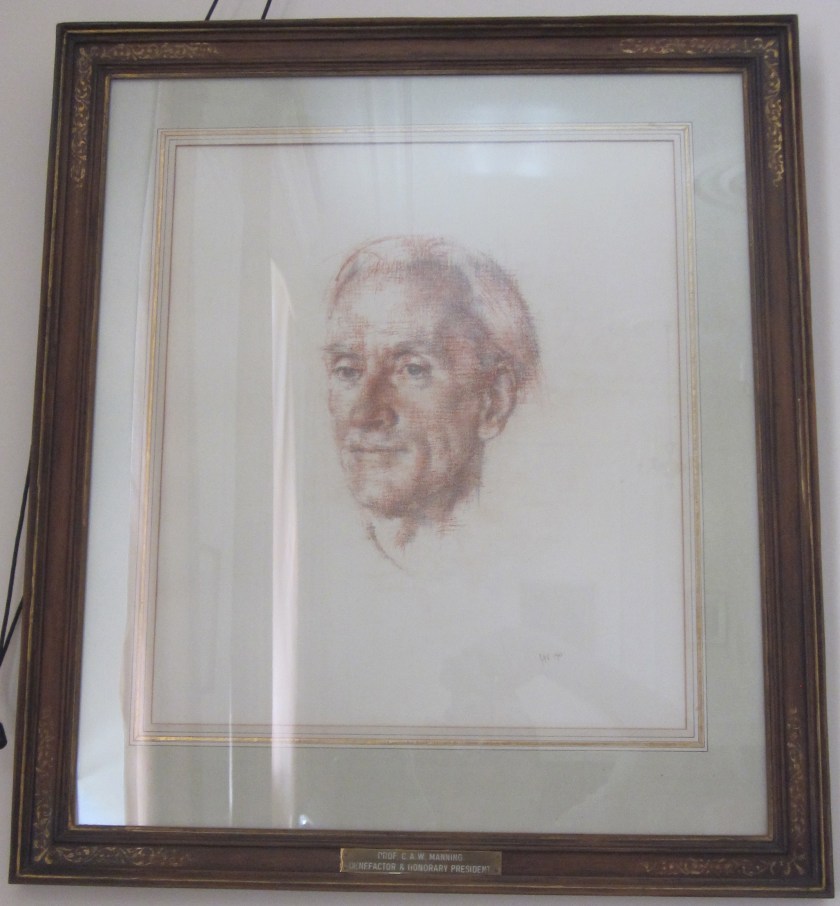
 C.A.W. Manning