Salmond on Jurisprudence, Sweet & Maxwell, 1930, pp. vii-viii.
Anybody who undertakes the editing of someone else’s legal treatise is faced from the first with a nice question of method, on which the room for difference of opinion is wide enough to make it unlikely that he will satisfy every taste. He will have to use his own discretion, explain to what conclusions it has led him and hope to find sympathy somewhere.
No one at any rate will doubt that the method must vary according to the character of the work itself. Suppose, for instance, the book only sets out to expound a particular body of law, such as the English law of libel, in its newest phase, the editor’s task would seem to be mainly that of bringing its propositions up to date. Where on the other hand it is a statement of the considered opinion of someone no longer living, on a subject for which there seem to be no universally accepted criteria of orthodoxy, the matter is otherwise: there are more· possibilities than one. Should the author’s central thesis have ceased to find favour, and should the editor happen himself to carry big enough guns, he may use it as a target for some constructive shooting of his own.
In the present instance – of a book which in its existing form remains almost without a rival in public estimation – the editor has judged that his work, though delicate in detail, should be slight in total result. His plan, in the main, has been simply to draft, as though for the late author’s consideration, those amendments, many of them purely verbal, to which he likes to believe that the author’s approval, had it been possible to ask for it, would have been given. In those rare cases where he lets in a reflection of his own, it is so worded as not to leave its source in doubt.
In deciding as to the utility of particular changes he has been guided by his notion of the needs of “the average student.” It is also by his sense of those needs that he is prompted to interpose at this point a word in regard to the type of argument that gives its general character to the book. It may easily happen that a passage so written as not too violently to disturb the thinking habits of the normal mind will by that very fact lose something of value to those readers whose goal it is, even at the cost of some mental discomfort, to arrive at a deeper understanding of the law. That which Lord Coke described as “the artificial reason and judgment of the law” is what the serious student must learn to exercise in his own behalf; and one of the functions of elementary jurisprudence is to drive this primary lesson home. Sir John Salmond, however, though differentiating neatly at the outset the analytical from the other modes of approach to the study of law, gives express reasons for not choosing himself to present an exclusively analytical treatment. Furthermore, though noticing here and there an illustration of the law’s relative unconcern for “the truth of things,” he seems in some other contexts implicitly to assu1ne a necessarily close correspondence of each with the other.
A text re-written in a more pedantic spirit would not, therefore, have been a due answer to the demand for a new edition of “Salmond.” It may however be useful if the student is advised fairly often to ask himself – What is it we now are discussing; is it the legal theory of modern England, or that of ancient Rome, or is it rather a point of general, or of universal, jurisprudence? Or are we now afloat upon the wide waters of the extra-legal; and, if yes, then in whose company – that of the legislator, or of the moral philosopher, or of the political scientist, or of the mere politician? The answers to these questions, when once they have been asked, ought as a rule to be perfectly plain and of an importance to justify their asking. All this, of course, is a purely personal view.
The slight verbal changes, already referred to, are scattered, without distinguishing mark, throughout the book. For this policy the editor alone is responsible. The reader who notices faults in the present edition will therefore do justly if he presumes them to be new: and the seventh edition will perhaps be at hand if he wants to make sure.
C.A.W.M.
London,
October, 1930.

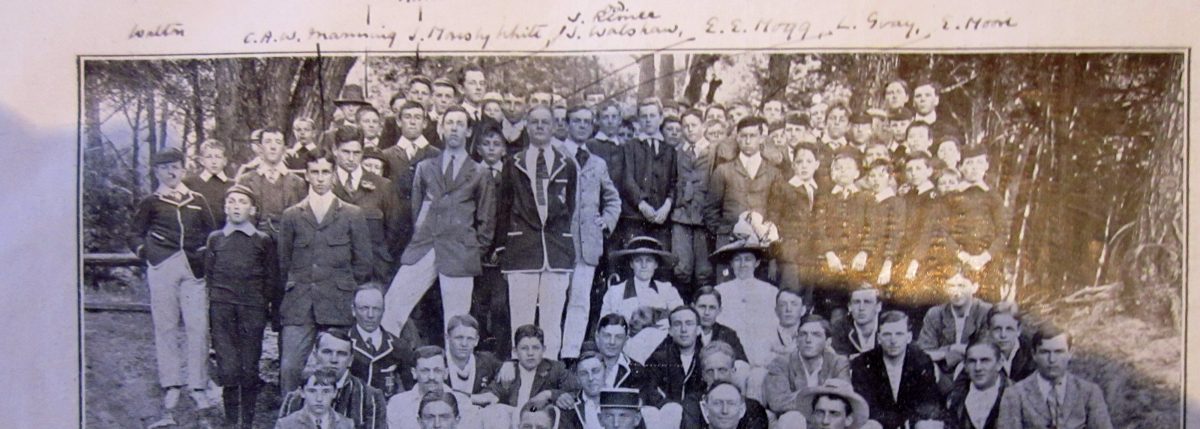
 C.A.W. Manning